

When Loving Them Feels Like Losing You: The Trap of People-Pleasing Our Children

It usually starts with a quiet, sacred promise whispered over a sleeping newborn: You will never feel the loneliness I felt. You will always be heard. We decide, with every fiber of our being, that our children will have the childhood we didn’t. So, we listen to every winding story, we curate the perfect "sensory bins," and we jump to fix every tiny discomfort like we’re diffusing a bomb.
But somewhere between the third toddler meltdown and the fifth year of "active parenting," that promise shifts. It stops being about their safety and starts becoming about our erasure.
We talk a lot about people-pleasing our bosses or “those” relatives (you know exactly who I’m talking about). We rarely name the specific, tender exhaustion of people-pleasing our own children. It’s a sneaky trap because it looks like "good parenting." It looks like devotion. But if the cost is your mental health, your marriage, or your basic ability to pee alone, it isn’t just parenting. It’s a trauma response—specifically fawning—wearing a very tired "Mom" sweater.
The Math Is Actually Against You
If you feel like you’re working harder than any generation before you, it’s because the data says you literally are. According to economist Corinne Low, the time moms spend with their kids has doubled since the 1980s, adding about seven extra hours of active labor to our weeks.
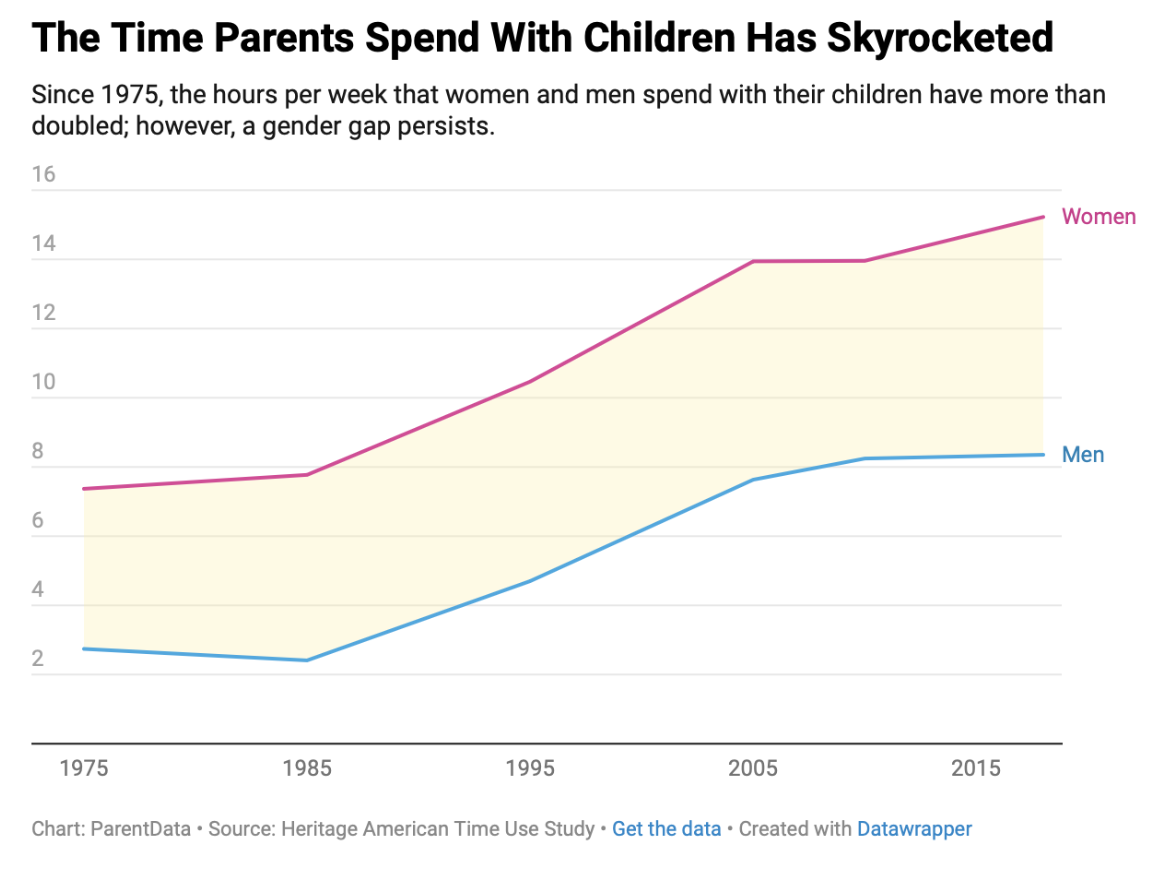
The sharp rise in these lines isn't just data. It represents hours of worry, devotion, and the invisible labor of trying to fill every gap. If you feel tired, this is why.
We’ve entered a "rug rat race" where we feel pressured to optimize every developmental milestone. We aren't just raising kids; we're "investing human capital" into them while our own internal accounts are overdrawn. If you feel like you’re failing at an impossible task, please hear me: The math has changed, and it is not your fault.
Why We Can’t Just Say "Go Play"
For many of us, our child’s distress triggers a five-alarm fire in our nervous system. If you grew up in a house where big emotions were dangerous or where you had to be "good" to be loved, a whining child feels like a threat to your safety.
In Internal Family Systems (IFS), we call this a "Manager" part. This part of you is working overtime, believing that if your child is unhappy, you have failed. This Manager thinks if they can just keep the "client" (your child) happy, the whole system won’t collapse.
This part has beautiful intentions—it’s trying to protect your child from the pain you knew. But in doing so, it accidentally protects them from learning they can survive a "no."
The "Legacy Burden" of the Martyr
When we people-please our children, we inadvertently teach them that love is transactional and that boundaries don't exist. Worse, we place a heavy burden on their small shoulders: the responsibility for our emotional well-being.
In my work, we look at legacy burdens—the beliefs and traumas we inherit from our ancestors. If we don’t set boundaries, we risk passing down the "martyrdom" script. Trauma may live in your story, but it doesn’t have to be your child’s inheritance.
Repair Over Perfection
The antidote to this exhaustion isn’t becoming a "cold" parent. It’s trusting that your relationship is strong enough to handle a limit.
When you tell your child, "I can't play right now because my body needs a rest," you aren't being mean. You are modeling self-respect. You are showing them what it looks like to be a real person, not a professional playmate.
And when you inevitably snap because you’re depleted? You get to practice repair. You get to say, "I was overwhelmed, and I’m sorry. Let’s try again". That moment of messy, human connection is infinitely more healing than a thousand hours of resentful, "perfect" presence.
A Gentle Permission
You do not have to earn your child’s love through your own suffering.
You can release the need to be the perfect buffer between your child and the world. You can trust that they are capable of handling big feelings, and that you are capable of witnessing them without fixing them.
Maybe the version of you that has needs, limits, and a life outside of motherhood is actually the person they most need to meet.
References: Low, C. (2025, December 12). Why parenting feels harder than ever. ParentData. https://parentdata.org/why-parenting-feels-harder-than-ever/
Did this resonate with you?
If you are looking for support as you navigate the intensity of parenthood and the work of breaking cycles, you may have found your landing place.
Reach out to us by filling out our contact form or giving us a call at 718-795-2879.
To follow us on Instagram, find us at @overturetherapy.