

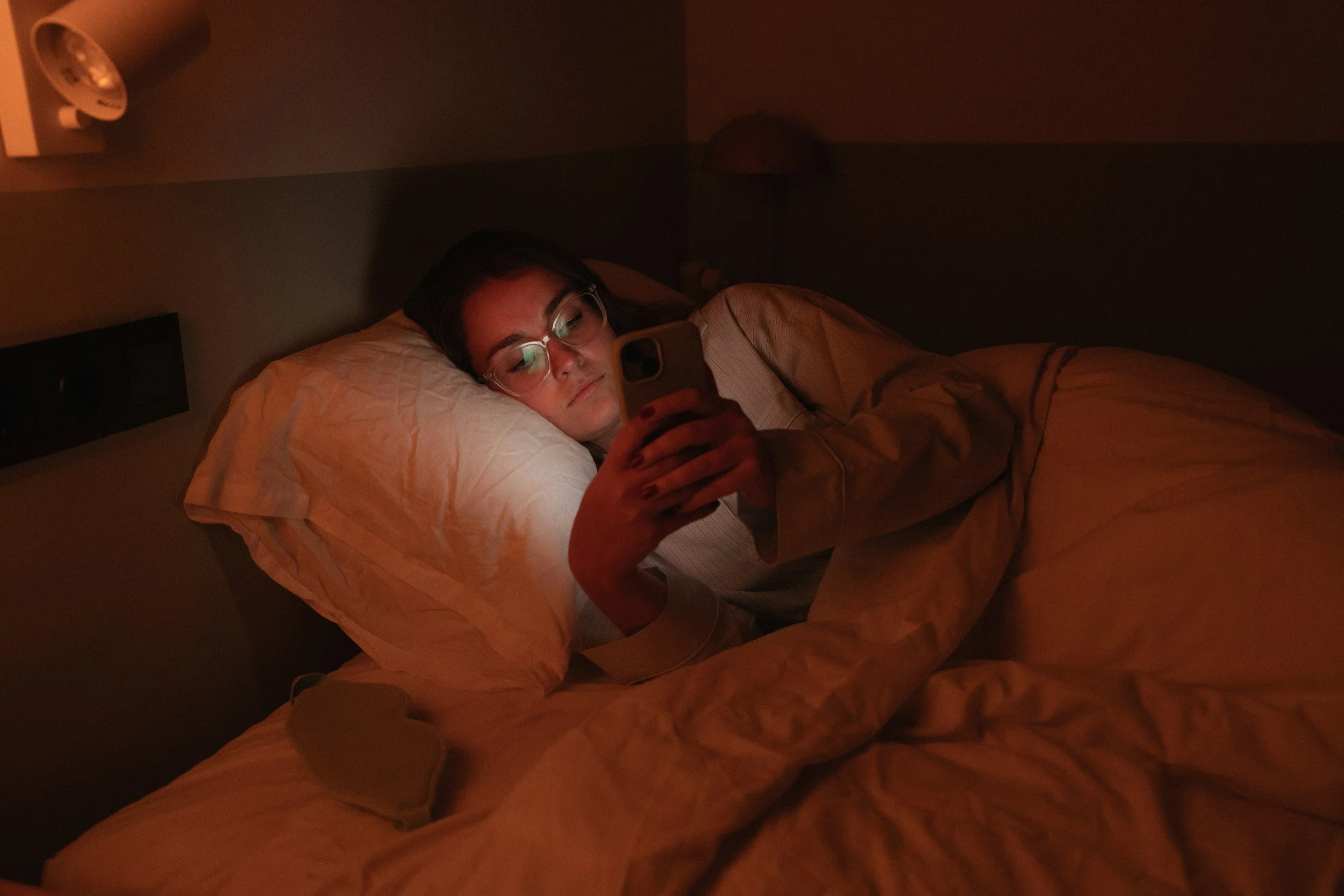
It's 9:40 on a Tuesday night in November. The kids are finally asleep, and you're on the couch holding your phone above your face. In the last four minutes you've seen a family of five at an apple orchard in coordinated rust and cream. You've seen a toddler holding a pumpkin her own size, smiling at the camera like she was paid. You've seen an apple crisp cooling on a windowsill that has never held a single piece of mail. Then comes a carousel from a mom you went to high school with, captioned "our favorite tradition."
So far your family's fall has included one stop at the pumpkin bin outside the grocery store, a Halloween costume that got renegotiated twice and abandoned by the third house, and a photo of your daughter sobbing in front of a hay bale because the hay was "too pokey."
Somewhere around the fourth orchard, a familiar voice clears her throat. She keeps score, and she is very organized about it. She has noted the orchard, the sweaters, and the fact that everyone in the photo seems to be having a lovely time. She would like to know what your excuse is. She does not mention what happened in that family's minivan twenty minutes before the photo. That's outside her department.
Two Halloweens ago, my daughter was almost two and still finding her footing, literally. She was walking later than most kids her age, and as we made our way around the neighborhood, I could feel my patience thinning with every block. I was dressed as Sven, the reindeer from Frozen, on a night that was inexplicably hot. At the last minute she had switched to a princess from a different movie entirely. Every few steps she asked to be carried, and every request turned the overwhelm up another notch.
Then our neighbors came around the corner. They were friendly, they were in weather-appropriate costumes, and they looked like they were genuinely having a good time. Their youngest was running circles around us. I smiled and waved, and I started planning when I could slip out to the car later that night to scream-cry.
If they had posted a photo that night, I'm fairly sure I'd have been in the background, waving.
Why your mind keeps score
Comparison is one of the oldest tools the mind has. In 1954, the psychologist Leon Festinger proposed that people evaluate their own abilities by comparing themselves with others, especially when there is no objective standard to go by (Festinger, 1954).
Motherhood has no objective standard. There is no performance review. Your direct reports are three and six, and their feedback arrives as either a hug or a full-body protest about socks. You are also in the middle of matrescence, the identity shift of becoming a mother, which means you're still finding out what kind of mother you are. So your mind does the sensible thing and looks for a reference point. On a phone, the nearest one is everyone else's best day, cropped, filtered, and chosen from about 140 attempts.
Your whole Tuesday, pokey hay included, gets measured against someone else's single best frame. The scorekeeper never adjusts for that.
What the feed adds
Researchers have studied this in mothers directly. In a survey of 721 mothers, Coyne and colleagues found that mothers who compared themselves to others more often on social media reported more overload in the parenting role, lower feelings of competence as parents, less perceived social support, and higher levels of depression (Coyne et al., 2017). The study measured associations, so it can't say which came first. The pattern still matches what we see in the therapy room: the act of comparing takes a toll on its own, apart from whatever you happened to be looking at.
None of this is neutral. The feed is designed to keep you scrolling, and fall content is built to sell sweaters, porch décor, pumpkins, and the idea of a tradition. Orchards, patches, corn mazes, a homemade costume: none of these were ever requirements for loving your children. They arrive every fall as if they were, and by November the list only grows: the family photo session, the matching pajamas, the holiday card. The scorekeeper logs each one as an assignment you missed.

What the pang is telling you
Sometimes the pang points at something you actually want. Maybe you miss being outside. Maybe you want a tradition that belongs to your family. Maybe you haven't had a slow Saturday in months. That's useful information, and you can act on it in a way that fits your actual family, your actual budget, and your actual children, one of whom will hate the hay.
Other times, the pang belongs to a standard you never chose. You don't care about apple picking. You have never once wanted to coordinate outfits for five people. But the scorekeeper saw someone else do it and filed it under things a good mother does. That one you can hand back.
Try this: "Do it or post it"
The next time a post gives you that drop in your stomach, stop before you keep scrolling and ask two questions.
What am I comparing? Name both sides honestly. Usually it's your full day, with all its mess and context, against one moment someone chose to share.
Do I want to do this, or do I want to have posted it? If you'd actually enjoy the orchard or the baking, plan a version that fits your life: smaller, closer to home, with lower odds of a meltdown. If what you want is the proof, the photo that says you're doing it right, that's the scorekeeper talking. Mute the account, close the app, and go to bed.
The first answer leads to something you'll enjoy. The second shows you a standard you can stop carrying.

When it's more than a bad scroll
Everyone has an evening of feeling behind. Pay attention if the comparison follows you long after you put the phone down. That can look like a steady sense that you're failing as a mother, low mood most days, losing interest in things you used to enjoy, or a constant belief that other mothers are doing it right and you aren't. Depression and anxiety during pregnancy and the years after birth are common and treatable. A therapist can help you tell the difference between a hard week and something that needs more support. You don't have to wait until it feels unbearable. The Postpartum Support International HelpLine is also available at 1-800-944-4773.
The photo of your daughter crying in front of the hay bale won't get posted. It's still the truest picture you took this fall.
References
Coyne, S. M., McDaniel, B. T., & Stockdale, L. A. (2017). "Do you dare to compare?" Associations between maternal social comparisons on social networking sites and parenting, mental health, and romantic relationship outcomes. Computers in Human Behavior, 70, 335–340. https://doi.org/10.1016/j.chb.2016.12.081
Festinger, L. (1954). A theory of social comparison processes. Human Relations, 7(2), 117–140. https://doi.org/10.1177/001872675400700202